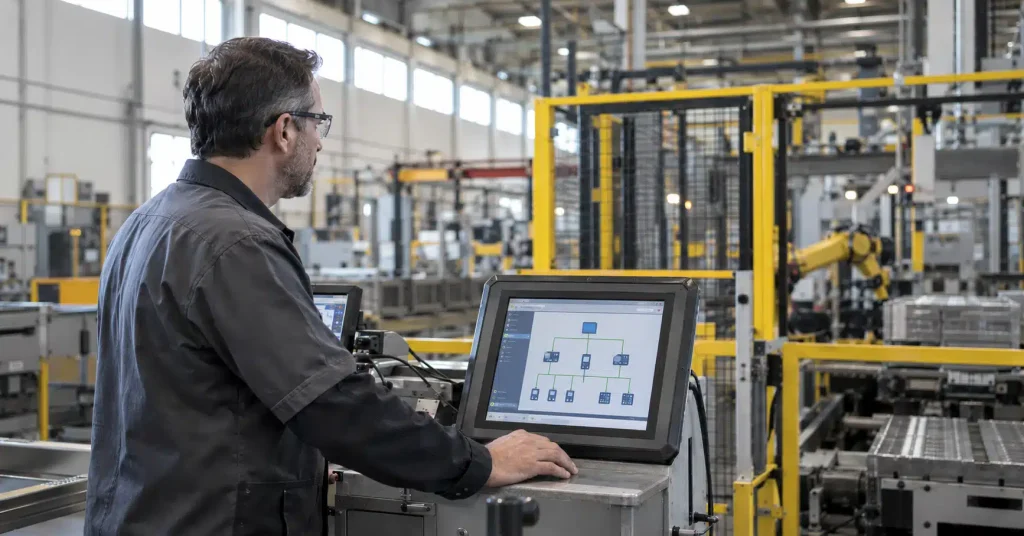
As Doug Lawson, the CEO of ThinkIQ, wrote for Forbes, “The top business priorities for manufacturers in 2023 should be to improve profit margins while reducing operating costs.” One method that offers a way to accomplish these goals is the adoption of Industry 4.0 tech. In other words, make your factory smarter.
The Growth of the Smart Factory Movement
Speedier and more self-sufficient, smart factories are helping operators transition into the next era of manufacturing and production while also addressing some of the current challenges facing the sector. Future Market Insights projects that the smart factory market is expected to reach nearly $400 billion by 2033. There are a few advances helping to drive this upward trend. For one, more and more enterprises are integrating Internet of Things (IoT) and machine learning (ML). And then you have the rise of robots.
Yes, robots are here and ready to put their built-in intelligence to work in your smart factory. With affordability beginning to balance out a bit and more sophisticated designs, the use of autonomous tools such as robotics is becoming more commonplace. The same goes for the rugged industrial PCs that run them on the factory floor. Gartner summarized that 75% of large enterprises are likely to implement some form of “intralogistics smart robots in their factories” by 2026, according to the Forbes piece.
Examples of Smart Factory Adoption
While there are several examples out there of sites where such tech is being put into play, BMW Group has announced plans for the world’s first “digital-first” factory. VentureBeat relays that BMW’s electric vehicle plant in Debrecen, Hungary, which is set to open in 2025, will be AI-driven and focus on “bridging the physical and virtual worlds,” as put by the VentureBeat team.
Aside from BMW, the semiconductor industry is proving to be another eager adopter of these innovations. With perks such as maximized productivity and minimized environmental impact, Semiconductor Engineering reports that semiconductor producers are doubling down on their investments in data analytics, IoT sensors, digitization, and robotics.
This is likely to continue as companies realize that smart factory solutions also offer boosts to competitiveness, help stabilize supply chains, and more. But, the transition will not come without its hiccups. Scaling may be an issue for some, as well as the overwhelming amount of data that such tech can lead to. A smart strategy for rolling out a smart factory will definitely emphasize taking the process gradually and seeking out input for how best to modernize and automate operations.
The DYNICS team has created products that both streamline difficulties such as data management and uphold cybersecurity, a key factor in this new age of factories. Reach out to set up your free consultation.
Securing Smart Factories as They Scale
The Capgemini Research Institute surveyed 950 organizations worldwide and found many insufficiently equipped for the growing cyberthreat picture. As the number of connected devices used to run smart factories rises, a large portion of those operators admitted they are overwhelmed. A major contributor is a lack of expertise, and 57% of Capgemini’s respondents said the smart factory cybersecurity talent shortage far outweighs the one in IT.
The report found that companies investing in cybersecurity leaders who direct teams in education and practice are far more likely to avoid an incident’s damage. Writing in Forbes, Dhrupad Trivedi added that service providers should “evolve their practices and prioritize security over mere compliance,” including a zero-trust architecture to address potential vulnerabilities. For a plant, leadership and practice come before any single purchase.
The Cybersecurity Manufacturing Innovation Institute, known as CyManII, is a coalition helping manufacturers including smart factory operators strengthen their safeguards, and released a roadmap resource toward that end. DYNICS is a member and supports the roadmap through its OT cybersecurity work. A plant can start with three checks.
- Count the connected devices on the network and flag any nobody owns.
- Name who owns smart factory cybersecurity and what training they run.
- Check current access practice against the CyManII roadmap.
Sources
- “How Advanced Industry 4.0 Solutions Are Proliferating Smart Factories” – Doug Lawson, Forbes
https://www.forbes.com/councils/forbestechcouncil/2023/04/20/how-advanced-industry-40-solutions-are-proliferating-smart-factories/ - “Smart factory market to reach almost $400 billion by 2033” – Future Market Insights, Plant Engineering
https://www.plantengineering.com/smart-factory-market-to-reach-almost-400-billion-by-2033/ - “AI is making smart manufacturing faster, greener, virtual — and more real” – VB Staff, VentureBeat
https://venturebeat.com/ai/ai-is-making-smart-manufacturing-faster-greener-virtual-and-more-real/ - “Smart Manufacturing Makes Gains In Chip Industry” – Anne Meixner, Semiconductor Engineering
https://semiengineering.com/smart-manufacturing-makes-gains-in-chip-industry/ - “Smart factories unprepared for cyberattacks” – John P. Mello Jr., CSO
https://www.csoonline.com/article/573097/smart-factories-unprepared-for-cyberattacks.html - “The connected nature of smart factories is exponentially increasing the risk of cyber attacks” – Help Net Security
https://www.helpnetsecurity.com/2022/07/06/smart-factories-attacks/ - “CyManII releases roadmap to protect manufacturers from cyber-attacks” – Emily Guajardo, UTSA Today
https://www.utsa.edu/today/2022/07/story/cymanii-roadmap-to-protect-manufacturers-from-cyber-attacks.html