Class 1 Div 1 vs Div 2 comes down to how likely an ignitable mixture is to be present. For the Occupational Safety and Health Administration (OSHA), Class I, Division 1 includes places where ignitable concentrations of flammable gas or vapor may exist in normal operation, or frequently because of repair, maintenance or leaks. OSHA’s note on Class I, Division 2 says it usually covers places where those materials are used but become hazardous only through an accident or an unusual operating condition.
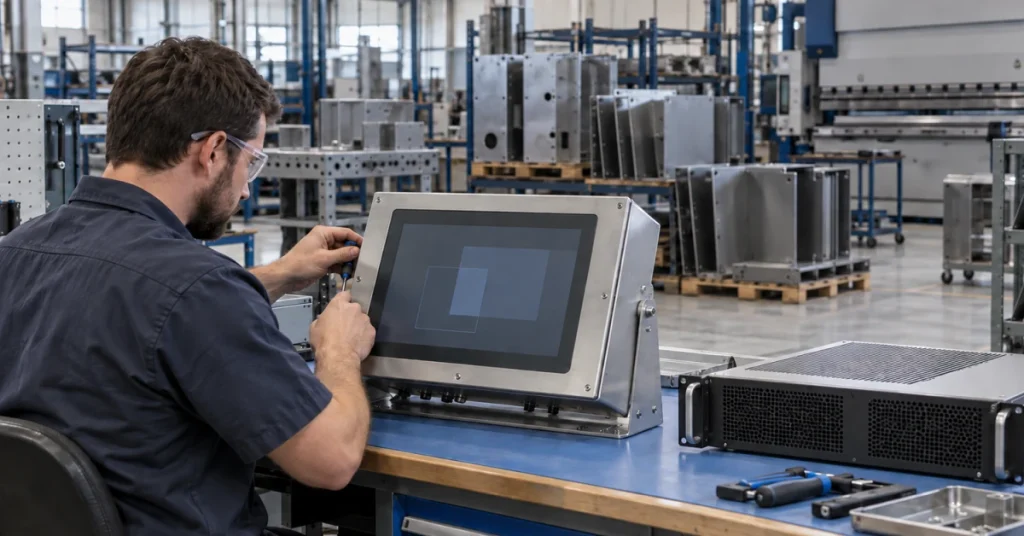
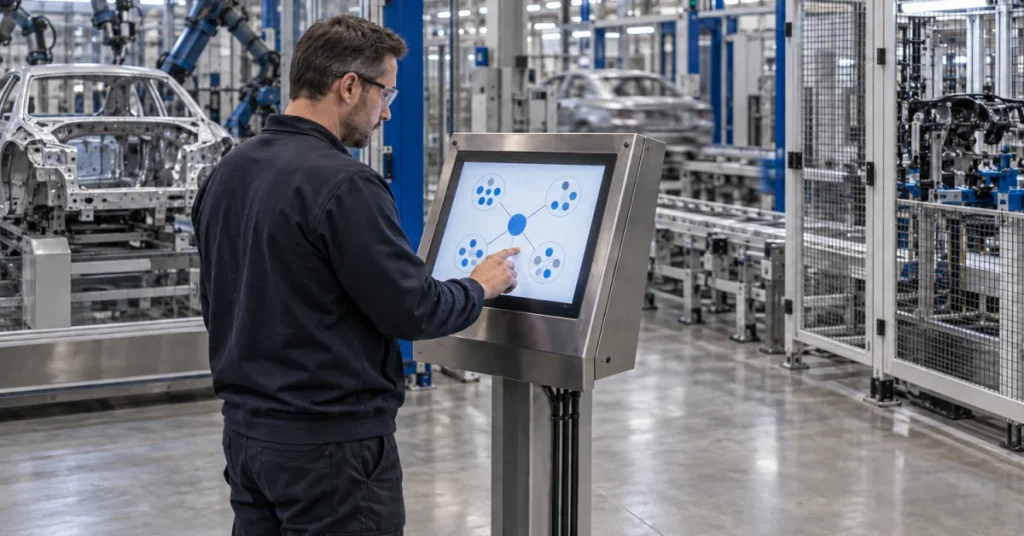
Class identifies the material, from flammable gas or vapor in Class I to easily ignitable fibers or flyings in Class III, with combustible dust in Class II. For an operator station, monitor or industrial computer in a classified area, the Class and Division decide which protection techniques OSHA permits. Dynics builds monitors, workstations and a computer for Division 2 areas.
Class and Division ratings at a glance
- Equipment approved for Division 1 may go into Division 2 of the same Class and Group.
- OSHA requires markings for Class, Group and operating temperature, with some exceptions.
- Under OSHA, only Class I may use Zones. Dust and fiber areas use Divisions.
- A recognized testing laboratory’s mark shows one route to OSHA approval.
How OSHA Defines Class 1 Div 1 vs Div 2
OSHA’s electrical definitions, in section 1910.399 of Title 29 of the Code of Federal Regulations (CFR), name three conditions that each make a Class I location Division 1. Ignitable concentrations may exist in normal operation, or frequently because of repair, maintenance or leakage. The third is a breakdown or faulty operation of equipment or processes that might release ignitable concentrations and, at the same time, cause electric equipment to fail.
OSHA’s explanatory note says Class I, Division 1 usually includes spray booth interiors and places where volatile flammable liquids or liquefied flammable gases are transferred from one container to another. Inadequately ventilated pump rooms for flammable gas or volatile flammable liquids are on the list too.
A Division 2 area meets any one of three conditions. Volatile flammable liquids or flammable gases may be handled or used but normally stay inside closed containers or systems, escaping only through an accidental rupture, a breakdown or abnormal operation. In another, positive mechanical ventilation normally prevents ignitable concentrations. If that ventilation fails or runs abnormally, the area might become hazardous. An area next to Division 1 also qualifies if gases or vapors might occasionally reach it, unless adequate positive-pressure ventilation from clean air, with effective safeguards against its failure, prevents that.
Class Names the Material, and the Group Narrows It
In Class II, Division 2, after infrequent malfunctioning of handling or processing equipment, accumulations on, in or near electric equipment may interfere with the safe dissipation of heat or be ignited if that equipment fails or runs abnormally. For fibers, OSHA’s note says Class III, Division 1 usually includes cotton gins, woodworking plants and some parts of textile mills.
NFPA 70, the National Electrical Code (NEC) of the National Fire Protection Association (NFPA), defines Groups by ignitable or combustible properties, OSHA’s note says. Groups A through D belong to Class I, with acetylene in Group A, according to a United States Coast Guard (USCG) bulletin summarizing NEC Article 500, which puts Groups E through G in Class II. Examples of typical gases for Groups B to D come from undated offshore guidance by the Bureau of Safety and Environmental Enforcement, which names hydrogen for B and ethylene for C. The guidance’s Group D examples include gasoline, methane and propane.
Metal dusts such as aluminum and magnesium go in Group E, says the combustible dust directive of Oregon OSHA, a state-plan agency. Group F covers carbonaceous dusts, such as coal, with more than 8 percent total entrapped volatiles. Other combustible dusts, flour and grain among them, fall in Group G.
Classifying the Area and Approving the Equipment
A location is classified by the properties of the material that may be present and the likelihood of a flammable or combustible concentration, under 29 CFR 1910.307, OSHA’s rule for hazardous locations. Each room, section or area is considered individually. Zone-system areas, and Division-system areas established after August 13, 2007, must be properly documented. For Zone-system areas, a qualified registered professional engineer must also supervise classification and equipment selection. The documented classification is the record to choose equipment against, and OSHA requires it to be available to those authorized to work with electric equipment at the location.
OSHA accepts equipment only if it is approved, meaning acceptable to the Assistant Secretary of Labor for Occupational Safety and Health. One route runs through a nationally recognized testing laboratory (NRTL) that lists, labels or otherwise determines the equipment to be safe. Each NRTL has its own registered certification mark. After certifying a product, the laboratory authorizes the manufacturer to apply that mark, according to the OSHA NRTL program. OSHA lists each NRTL with its recognized scope of test standards.
Protection Techniques and Placement Rules by Division
Equipment in a hazardous location can qualify under OSHA by being intrinsically safe or approved for the location. A third option, safe for the location, rests on the employer demonstrating that the equipment’s type and design protect against the hazards involved. OSHA’s list of acceptable techniques runs by Class and Division. Any other technique that meets the same rule is acceptable too.
| Technique |
|---|
| Where OSHA permits it |
| Explosionproof apparatus |
| Class I, Division 1 and 2 locations for which it is approved |
| Dust-ignitionproof |
| Class II, Division 1 and 2 locations for which it is approved |
| Dust-tight |
| Class II, Division 2 and Class III locations for which it is approved |
| Purged and pressurized |
| Any hazardous location for which it is approved |
| Nonincendive circuits, equipment and components |
| Class I, Division 2, Class II, Division 2, or Class III, Division 1 or 2 |
| Oil immersion |
| Current-interrupting contacts in Class I, Division 2 |
| Hermetically sealed |
| Class I, Division 2, Class II, Division 2, and Class III, Division 1 or 2 |
OSHA defines explosionproof apparatus as enclosed in a case that can withstand an explosion of a specified gas or vapor inside it and prevent ignition of the gas or vapor around it. The definition also requires an external temperature that will not ignite the surrounding atmosphere. Intrinsically safe equipment takes a different approach, which the same offshore guidance describes as keeping energy below what is needed to ignite the atmosphere, even under fault conditions.
UL 121201, a standard from the developer UL Standards and Engagement, describes nonincendive equipment as not capable of causing ignition of the surrounding atmosphere in normal operation under the conditions it prescribes. The standard’s scope is Division 2 in Class I and Class II, and Divisions 1 and 2 in Class III.
OSHA permits intrinsically safe equipment in any hazardous location for which it is approved. Equipment approved for Division 1 may be installed in Division 2 of the same Class and Group. If the employer can demonstrate that general-purpose equipment is not a source of ignition under normal operating conditions, it may go into Division 2 as well.
Specify Division 2 Hardware for Your Classified Area
Send the Class, Division and Group from your area classification with a quote request for a Dynics monitor, workstation or computer.
Read the Nameplate Before the Equipment Goes In
OSHA’s marking rule requires equipment to show the Class, the Group and the operating temperature or temperature range it is approved for, based on a 40 °C ambient. Division is not on that required list. Equipment fit for Class 1 Div 1 vs Div 2 rests on OSHA’s three ways to qualify and the placement rules above.
Temperature class, or T-code, is the maximum safe operating temperature of equipment, matched to the ignition temperature of the substances present or likely to be present, in a USCG bulletin’s definition. Its copy of the NEC Article 500 table runs from T1 at 450 °C (842 °F) down to T6 at 85 °C (185 °F), so a higher T number means a lower maximum surface temperature. In the bulletin’s example, acetylene ignites at 305 °C. If it has the lowest ignition temperature present, T2 is the minimum class and T2 through T6 all qualify.
- Class and Group against the site. Compare the marked Class and Group with the site’s classification and the specific material present. OSHA requires approval for the Class of location and for that material’s ignitable or combustible properties.
- Temperature against the gas. The temperature marking may not exceed the ignition temperature of the specific gas or vapor. The USCG advises rating all equipment to the temperature class of the lowest ignition temperature expected, and a higher class may stand in for a lower one.
- Above a 40 °C ambient. Equipment suitable above 40 °C (104 °F) must show the maximum ambient temperature and the operating temperature or range at that ambient.
- An NRTL mark. Where approval takes the NRTL route, look for the laboratory’s mark.
- The listing’s instructions. Listed or labeled equipment must be installed and used according to any instructions in its listing or labeling.
One OSHA marking exception lets equipment that produces no heat, or reaches no more than 100 °C (212 °F), go without an operating temperature. A second exception goes further. Fixed general-purpose equipment in Class I locations, other than lighting fixtures, that is acceptable for Class I, Division 2 need not show Class, Group or operating temperature, nor the Division.
The Ratings on the Dynics Certificate
Two of the three series on the Dynics UL Certificate of Compliance, number E509663, share one rating line. The panel-mount hazardous-location monitor series and the hazardous-location industrial workstation series carry Class I, Division 2, Groups A, B, C and D, plus Class II, Division 2, Groups F and G, and Class III. The standalone hazardous-location computer carries Class I, Division 2, Groups A, B, C and D only, with no Class II or Class III rating.
UL 121201 is in the recognized scope of the issuer, UL LLC, which is on OSHA’s NRTL list as of October 2026. CSA C22.2 No. 213-17, the binational match to UL 121201 from the standards body CSA Group, is on the certificate too. For Class I and Class II, both standards and the certificate’s rating lines cover Division 2 only, while a Division 1 area in either Class needs one of the techniques OSHA permits there. The Class II line names no Group E, the metal dusts that Oregon OSHA’s directive says make only Division 1 locations when present in hazardous quantities.
The certificate itself does not authorize use of the UL Mark. Only UL’s Follow-Up Services Procedure does, and only products bearing the mark are covered under UL’s Follow-Up Services. The certificate tells readers to look for the UL Certification Mark on the product, the NRTL mark the nameplate check calls for, and points to the UL Online Certifications Directory.
Frequently Asked Questions About Class and Division Ratings
What is the difference between Class 1 Div 1 and Div 2?
Places where ignitable concentrations of flammable gas or vapor may exist in normal operation fall in Division 1. Division 2 includes places where the gas or vapor normally stays in closed containers or systems, or where positive mechanical ventilation normally prevents ignitable concentrations. A rupture, a breakdown, or ventilation that fails or runs abnormally can make those places hazardous. A United States Coast Guard table pairs continuous presence with Division 1 and abnormal conditions with Division 2.
What is Class 1 Div 2?
Class I, Division 2 covers places where flammable liquids, gases or vapors are handled or used but normally stay in closed containers or systems, or where positive mechanical ventilation normally prevents ignitable concentrations. Areas next to Division 1 belong too when vapors might occasionally reach them, unless adequate, safeguarded positive-pressure ventilation from clean air keeps vapors out. Piping without valves, checks, meters and similar devices would not ordinarily introduce a hazard, OSHA’s note adds. Sealed-container storage is not normally considered hazardous either, unless other hazardous conditions apply.
Can Division 1 equipment be used in a Division 2 location?
Division 1 equipment can go into Division 2 if it is approved for a Division 1 location of the same Class and Group. OSHA’s zone rules for Class I contain a similar permission, under which equipment listed for Zone 0 may be installed in a Zone 1 or Zone 2 location of the same gas or vapor.
Does Class 1 Div 2 require explosion proof equipment?
No. Explosionproof apparatus is one of several techniques OSHA permits in Class I, Division 2, and nonincendive equipment is another. The National Electrical Code also permits some equipment designed for unclassified locations there, with acceptability judged by the authority having jurisdiction, according to a note in CSA C22.2 No. 213, the binational nonincendive standard.
What is Class 2 Div 1?
Class II, Division 1 is a combustible dust location where dust is or may be suspended in the air in ignitable quantities under normal operating conditions. It also covers places where a machinery failure might produce such a mixture and, through simultaneous failure of electric equipment, a source of ignition, or where electrically conductive dust may be present. OSHA’s note says it may include areas of grain handling and processing plants, starch plants and sugar-pulverizing plants.
What is the difference between Divisions and Zones?
OSHA allows Zones as an alternative to Divisions for Class I locations only, and Class II and Class III locations must use Divisions. Zone 0 means ignitable concentrations are present continuously or for long periods. Zone 1 includes places where they are likely in normal operation, and Zone 2 includes places where they are unlikely and short-lived if they occur. Within one facility, Zone 2 may abut Division 2 but not overlap it.
Questions Before a Division 2 Installation
Ask a Dynics engineer what each product’s rating covers, and what it leaves out, for the area your site has classified.