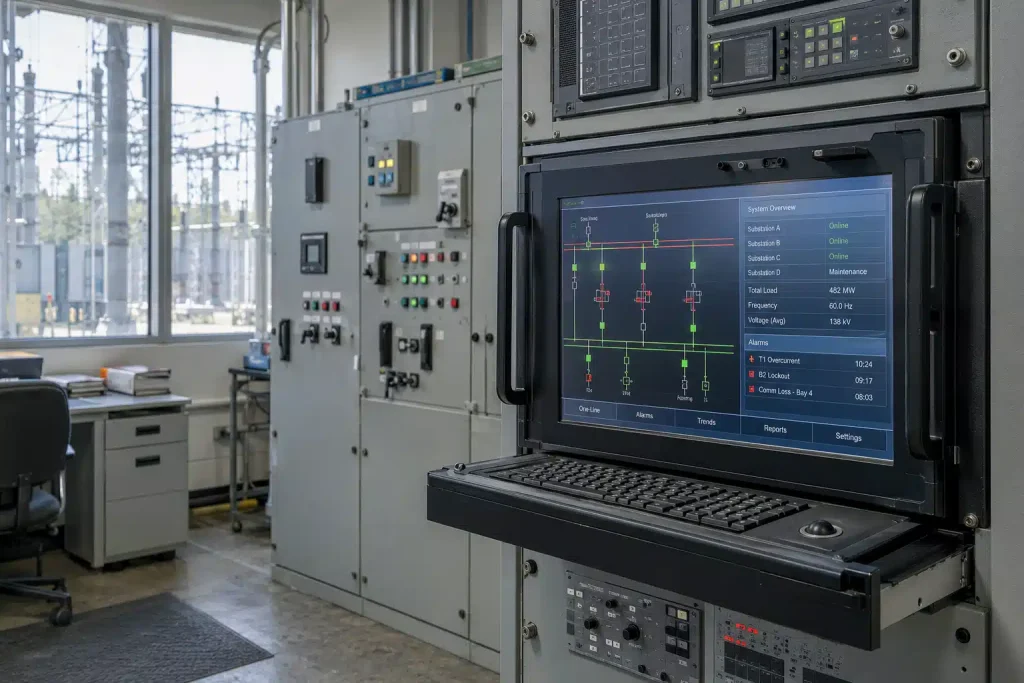
An industrial control system, or ICS, was built to do one job well. That job is keeping a physical process running safely and without interruption. For most of the last fifty years, that job had nothing to do with networking, and neither did ICS security. The programmable logic controllers (PLCs) running a water treatment line or a stamping press were never meant to talk to the internet, and for a long time, they didn’t.
That’s changed. Plant floors now run on connected sensors, remote monitoring dashboards, and vendor support links that reach back through the corporate network. ICS security is the discipline of protecting those connected control systems (the hardware, the software, and the people operating them) from threats that can shut down a line, damage equipment, or put a worker’s safety at risk. It borrows tools from IT cybersecurity, but the stakes are different. A failed IT patch might mean a slow afternoon. A failed OT (operational technology) safeguard can mean a plant that doesn’t come back online for a week.
This guide walks through what ICS security actually covers, why these systems are harder to protect than a typical office network, what happened the last few times attackers got in, and what a workable defense looks like when it has to survive on the plant floor.
What Does ICS Security Actually Cover?
ICS is a broad term. It covers supervisory control and data acquisition (SCADA) systems that monitor pipelines and grids from a central control room, distributed control systems (DCS) that run continuous processes like refining, and the PLCs and human-machine interfaces (HMIs) that operators use to run a single line or cell. Some ICS environments also include safety instrumented systems (SIS), the last line of defense that shuts a process down before it becomes dangerous.
Securing all of that means protecting three things at once.
- The devices themselves, meaning the PLCs, sensors, drives, and industrial PCs that read and act on physical data.
- The network that connects them, meaning the switches, wireless links, and remote-access paths that carry commands and readings between devices, operators, and higher-level systems.
- The people and processes around them, meaning who has access, how changes get approved, and how a maintenance window gets handled without opening a door an attacker can walk through.
An OT-native security program treats all three as one system, because attackers rarely stop at the first one they reach.
Why Industrial Control Systems Are Uniquely Hard to Protect
A lot of IT security advice doesn’t translate to the plant floor. Pretending it does is how good security teams end up creating new problems instead of solving old ones. I’ve watched this disconnect play out across enough OT security conversations to know it comes down to a few specific things.
- Legacy protocols weren’t built with security in mind. Modbus, DNP3, and similar industrial protocols were designed decades ago to move data reliably between devices, not to authenticate who’s sending it. Many of them will accept a command from any device that speaks the protocol correctly, no credentials required.
- The air gap myth still gets repeated. Plenty of operators believe their control network is physically isolated from the internet. In practice, a vendor support connection, a USB drive used for a firmware update, or one misconfigured firewall rule is usually enough to close that gap without anyone noticing.
- Equipment lifecycles run 15 to 25 years, not three. A control system installed in 2008 might still run its original operating system, because replacing it means a planned outage, requalification, and a capital request most plants can’t approve on short notice.
- Uptime outranks patching. In IT, a critical vulnerability usually gets patched within days. On a production line, that same patch might have to wait for the next scheduled maintenance window, because taking a safety-critical controller offline mid-shift carries its own risk.
None of this means ICS security is a lost cause. It means the approach has to start from how these systems actually get used, not from an IT playbook with the word “industrial” stapled onto it.
Real-World Attacks That Changed How the Industry Thinks About ICS Security
Three incidents did more to shape modern ICS security thinking than any whitepaper. Each one shows a different way an attack on operational technology turns into a physical consequence, not just a data problem.
- Triton, also called Trisis (2017). Attackers spent roughly a year inside the corporate network of a Saudi petrochemical plant before reaching the safety instrumented system that would trigger an emergency shutdown if conditions turned dangerous. The malware was designed to disable that safety layer. A logic error in the code caused the plant to shut down safely instead of the outcome the attackers likely intended, which investigators have since described as a near miss with the potential for a toxic gas release or explosion. It was the first known malware built specifically to target a safety system.
- Colonial Pipeline (2021). A ransomware attack compromised Colonial Pipeline’s business network, not its pipeline control systems directly. The operator shut the pipeline down anyway, because it couldn’t confirm the attackers hadn’t reached the operational side too, and running blind wasn’t an option. The result was a six-day outage, fuel shortages across the Southeast and East Coast, and a $4.4 million ransom payment. The lesson mattered as much as the attack. When IT and OT networks aren’t cleanly separated, an IT-only breach can still take a plant down.
- Ukraine’s power grid (2015). Attackers used the BlackEnergy malware to get into three Ukrainian energy distribution companies, then took remote control of the SCADA systems operators used to switch substations on and off. Around 230,000 people lost power for one to six hours. Attackers also disabled backup generators at two of the utilities and flooded a call center with fake calls so customers couldn’t report the outage. It remains the first publicly confirmed cyberattack to cause a blackout.
Different industries, different attackers, same pattern. Once someone reaches the control layer, the damage stops being digital. CISA’s industrial control systems program tracks these incidents closely and publishes advisories as new ones surface.
See how the ICS360 suite maps to a defense-in-depth architecture. Explore Dynics OT cybersecurity
The Frameworks That Govern ICS Security
Three frameworks come up constantly in ICS security conversations, and each answers a different question.
- IEC 62443 is an international standard written specifically for industrial automation and control systems. It organizes a plant network into zones (groups of assets with shared security needs) and conduits (the controlled paths between them), then assigns each zone a security level from SL 1 to SL 4 based on how capable an attacker it needs to withstand. Environments requiring compliance with IEC 62443 use it as the technical blueprint for how a network gets segmented in the first place.
- NIST CSF (the Cybersecurity Framework from the National Institute of Standards and Technology) is broader and less industrial-specific. Its current version organizes a cybersecurity program around six functions (Govern, Identify, Protect, Detect, Respond, and Recover), and it’s often used as the executive-level structure that IEC 62443’s more technical detail plugs into. NIST also publishes SP 800-82, a guide focused specifically on operational technology, which maps closely to how ICS environments actually run.
- NERC CIP (Critical Infrastructure Protection standards from the North American Electric Reliability Corporation) applies specifically to the bulk power system, the utilities and grid operators that keep electricity flowing across North America. Unlike the other two, NERC CIP compliance is mandatory for the entities it covers, with real penalties for gaps.
None of these frameworks are a checkbox exercise. Dynics products support environments requiring compliance with IEC 62443, NIST CSF, and NERC CIP, but the frameworks themselves only matter if the underlying hardware and network can actually do what the paperwork claims.
What a Defense-in-Depth Model Looks Like on the Plant Floor
Defense-in-depth means layering protections so that one failure doesn’t expose the whole system. On paper, most vendors describe this the same way. In the conversations I have with plant engineers at events like S4 and Level Zero, the gap always shows up in the same place. A software-only approach and a hardware-plus-software approach handle the same layer very differently. Segmentation, for example, gets talked about as if any software-defined networking (SDN) tool solves it. In practice, it depends on whether that tool was built for OT traffic in the first place.
| Layer | Common Software-Only Approach | Hardware + Software Approach |
|---|---|---|
| Network | Firewall rules added onto switches that weren’t built for OT traffic | Managed switches and an SDN controller built to segment OT zones at the wire |
| Edge | A generic firewall inspecting traffic it wasn’t designed to understand | Deep packet inspection built for Modbus, DNP3, and EtherNet/IP, so the firewall reads the protocol instead of guessing at it |
| Device | A security agent competing with the PLC or HMI for limited memory and CPU cycles | Ruggedized industrial hardware sized to run securely without starving the control process it supports |
Swipe to see the full table on smaller screens.
The gap between those two columns is where most ICS security programs actually fail. A firewall that doesn’t speak Modbus can’t tell a legitimate command from a malicious one. An agent that competes with a PLC for resources can end up disabled the first time the plant needs every cycle for the process itself.
How Dynics Builds ICS Security Into the Hardware
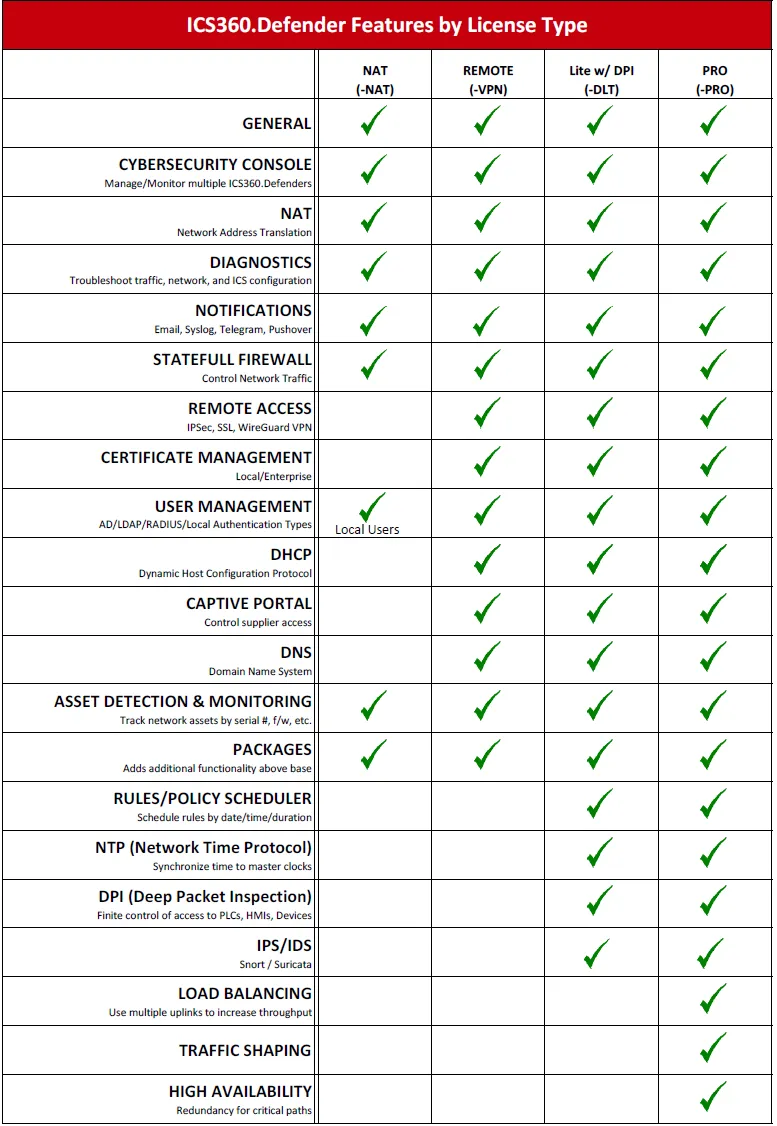
Dynics has spent 30 years designing, fabricating, and assembling industrial hardware on the plant floor in Ann Arbor, Michigan, which is why the ICS360 suite doesn’t treat OT security as a network afterthought bolted onto IT tools. ICS360.Defender runs deep packet inspection built for industrial protocols. The OT SDN Controller handles the network segmentation that IEC 62443’s zones and conduits model calls for. ICS360.IAM manages who gets access and when. Because the same team that builds the ruggedized industrial PCs also builds the security stack that runs on them, there’s no gap between what the hardware can handle and what the security software expects it to do.
Frequently Asked Questions
What is ICS security?
ICS security is the practice of protecting industrial control systems (the PLCs, SCADA systems, HMIs, and safety systems that run physical processes) from cyber and physical threats that could interrupt operations, damage equipment, or put workers at risk.
How is ICS security different from IT security?
IT security is built around protecting data. ICS security is built around keeping a physical process running safely. That difference changes the priorities. IT teams patch fast and expect systems to reboot. ICS teams have to weigh every change against production uptime and worker safety, which is why a security tool built for an office network often causes more problems than it solves on a plant floor.
What are the biggest threats to industrial control systems?
Ransomware that spreads from IT into OT networks, remote access left open for vendors or contractors, outdated protocols that accept commands without authentication, and purpose-built malware aimed at safety systems (like Triton/Trisis) are the threats security teams see most often. Human error and unmanaged remote connections cause more incidents than sophisticated attacks do.
What frameworks govern ICS cybersecurity?
IEC 62443 governs how industrial networks get segmented into zones and conduits. NIST CSF provides a broader, executive-level structure for managing cybersecurity risk, supported by NIST SP 800-82 for OT-specific guidance. NERC CIP is mandatory for bulk power system utilities in North America. Most industrial operators end up drawing on more than one, depending on their sector.
Why is network segmentation critical for SCADA and OT environments?
Segmentation keeps a breach in one zone from spreading to the rest of the plant. Without it, an attacker who compromises a single workstation on the business network can move laterally until they reach the SCADA system controlling physical equipment, the way attackers did in the 2015 Ukraine grid attack. Software-defined segmentation at the network layer is one of the more direct ways to contain that kind of movement.
What does ICS mean in a cybersecurity context?
In cybersecurity, ICS refers to the combined hardware and software that monitors and controls physical industrial processes, including SCADA systems, distributed control systems, and the PLCs and HMIs on a plant floor. Security teams treat ICS as its own category because these systems interact with the physical world in ways a typical IT server never does.
A production line that goes down because of a cyberattack costs more than the ransom or the recovery bill. It costs the hours a plant isn’t running, the orders that slip, and the trust customers place in a facility that’s supposed to be dependable.
Talk to a Dynics ICS Security Engineer about what a defense-in-depth model looks like for your specific plant floor, protocols, and equipment.