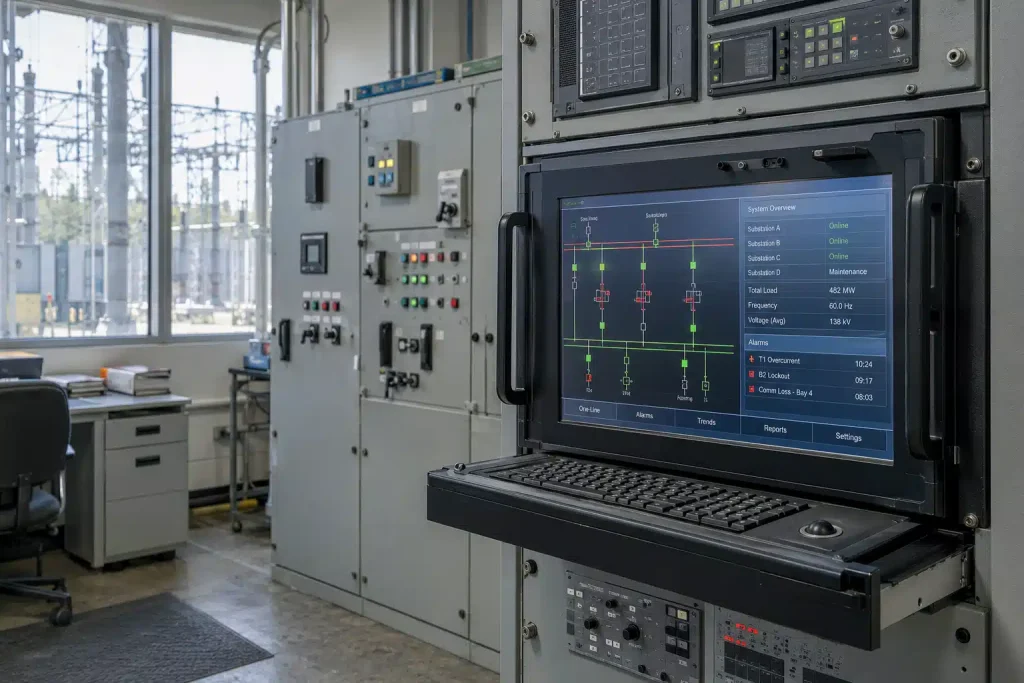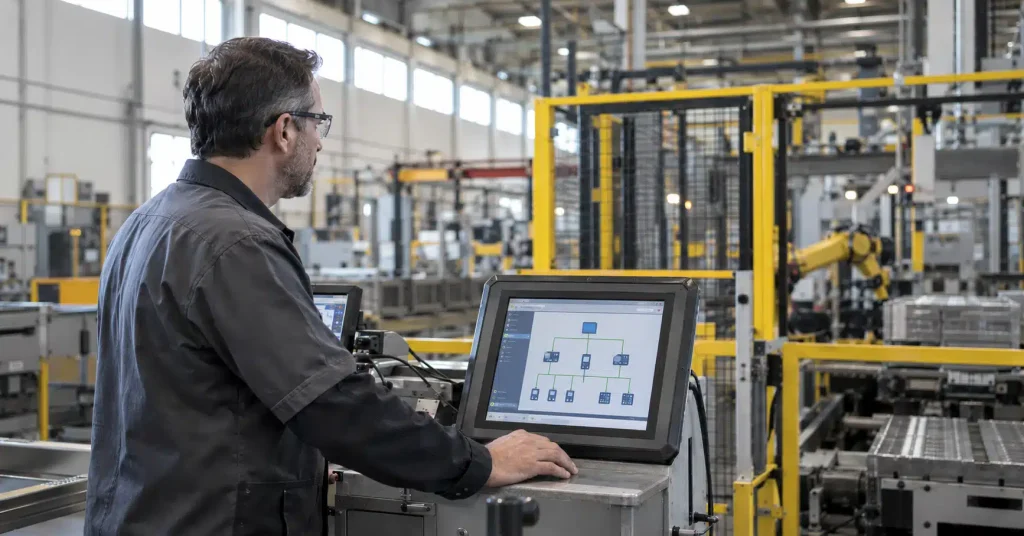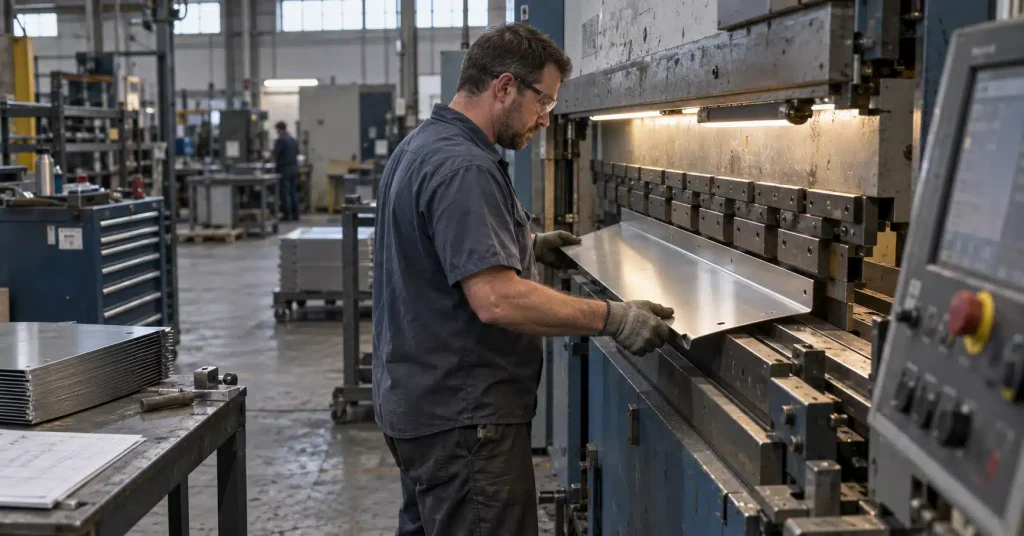
A fan is the single moving part standing between your industrial computer and a maintenance call it didn’t need to have. On a clean office desk, that’s a minor inconvenience. On a plant floor coated in flour dust, cutting fluid, or metal shavings, it’s a failure point with a countdown timer. That’s the core reason engineers keep specifying a fanless industrial PC for harsh production environments instead of trusting a standard PC’s cooling fan to survive conditions it was never built for.
We’ve spent 30 years designing computing hardware for the same plant floors our customers run – Ford’s assembly lines, food production lines shipping under labels like Coca-Cola and Perdue Farms, automotive foundries pouring metal at temperatures that would shut a laptop down in minutes. Here’s what a fanless industrial PC actually is, the specific failure modes it’s built to avoid, and how to tell whether your environment genuinely calls for one.
What Is a Fanless Industrial PC?
A fanless industrial PC is a ruggedized computer that removes heat through a solid metal chassis instead of a spinning fan. Heat generated inside the unit conducts directly into the enclosure, which acts as a passive heat sink and radiates it into the surrounding air. Because there is no fan drawing outside air through a vent, there is no open path for dust, moisture, or airborne particulate to reach the internal components.
Passive cooling means more than “no fan” – it changes what the computer is allowed to be exposed to. A fan-cooled PC needs vents, and vents need clear airflow, which means the enclosure can never be fully sealed without trapping heat inside. A fanless design solves the same thermal problem a different way – lower-power industrial-grade processors, a chassis engineered to spread heat evenly across its surface, and, on higher-output models, external fins that add surface area for radiating heat. There’s a real tradeoff here – fanless units generally can’t match the top-end processing power of an actively cooled desktop tower. For plant-floor applications – HMI displays, SCADA nodes, machine vision controllers – that tradeoff almost always favors the fanless side, because a computer that keeps running reliably beats one that’s faster right up until its fan seizes.
Where Fanless Industrial PCs Earn Their Keep
Not every application needs a fanless unit, and over-specifying hardware for an environment that doesn’t call for it just adds cost. But certain plant-floor conditions turn a cooling fan from a convenience into a liability.
- Food and beverage washdown lines – Equipment gets hosed down with hot water and cleaning chemicals between shifts. A fan-cooled PC either lives outside the wash zone in a separate enclosure, or it fails the first time water finds the vents. Food and beverage producers running washdown-heavy production depend on sealed, fanless hardware because the cleaning process isn’t optional – it’s a food-safety requirement.
- Automotive foundries and paint shops – Airborne metal particulate, sustained heat, and constant vibration from stamping and welding equipment define this environment. A spinning fan pulls in the particulate it’s supposed to be protected from, and vibration accelerates bearing wear in ways a solid-state, fanless design never experiences. It’s part of why automotive manufacturers spec fanless hardware for plant-floor stations.
- Outdoor and hazardous-location enclosures – Kiosks, remote monitoring stations, and equipment installed in Class I/II/III hazardous locations need an enclosure that can be fully sealed against weather and combustible atmospheres. A fan defeats that seal by definition.
- High-vibration mounted equipment – Rackmount chassis and panel-mount computers bolted directly to machinery absorb the same vibration the machinery generates. Moving parts, including fan bearings, are the first thing to fail under sustained mechanical stress.
- Dust-sensitive and contamination-controlled production – Some environments need to keep contamination from escaping the equipment as much as they need to keep it out. A sealed, fanless chassis doesn’t recirculate internal dust or debris back into the surrounding air.
Signs Your Environment Needs a Fanless Unit
If you’re not sure whether your application crosses that line, run through these questions before you spec a standard PC.
- ✓ Does the area see airborne dust, flour, metal shavings, or fiber that a fan would pull directly across the circuit board?
- ✓ Is the equipment washed down, sprayed, or exposed to humidity as part of normal operation?
- ✓ Does the mounting location see sustained vibration – stamping presses, conveyor lines, mobile equipment?
- ✓ Would an unplanned failure here stop a production line, not just inconvenience one workstation?
- ✓ Does the application require a specific IP rating or a Class I/II/III hazardous-location rating?
If two or more of those are genuinely “yes,” a fanless industrial PC probably isn’t optional. This is where temperature range and IP rating start to matter as much as processor speed. IEC 60529, the international standard that defines Ingress Protection ratings, is the reference point most engineers use to compare enclosure protection – the first digit covers solid particle intrusion, the second covers liquids. A unit rated IP65 or higher is a reasonable baseline for dusty plant-floor conditions, and washdown environments typically need higher liquid protection on top of that.
Fanless vs. Fan-Cooled – How They Actually Compare
Here’s the tradeoff sheet, factor by factor.
| Factor | Fan-Cooled PC | Fanless Industrial PC |
|---|---|---|
| Cooling method | Active airflow across internal components | Passive conduction through a solid chassis |
| Ingress exposure | Open vent path for dust, moisture, debris | No vent path; protection depends on chassis rating |
| Moving parts to fail | Fan motor and bearings | None |
| Vibration tolerance | Fan bearings wear faster under sustained vibration | No bearings to wear |
| Typical use case | Climate-controlled offices, server rooms | Washdown lines, foundries, outdoor cabinets, hazardous locations |
| Processing headroom | Generally higher – fans support higher-wattage components | Generally lower – sized to what passive cooling can dissipate |
Neither column is universally the right answer. A fan-cooled workstation in a climate-controlled control room has no real disadvantage. The decision comes down to what’s actually on the other side of the enclosure door on your specific production floor.
Built to Handle It, Not Just Survive It
Dynics designs and builds its small-format industrial computers – panel PCs, computer nodes, and integrated workstations – in our Ann Arbor, Michigan facility, with fanless configurations available across the line for the environments described above. Every unit ships with its environmental rating documented up front, not buried in a footnote, because the automotive, food and beverage, and defense manufacturers running our hardware need to verify it against their own compliance requirements before it goes anywhere near the floor.
Need a fanless industrial PC for a specific environment? Tell us your application and we’ll spec it.
Frequently Asked Questions About Fanless Industrial PCs
What is a fanless industrial PC?
A fanless industrial PC is a ruggedized computer that cools itself through a solid metal chassis instead of a spinning fan, with no ventilation opening for dust, moisture, or debris to enter through.
How does passive cooling keep a fanless industrial PC from overheating?
Heat generated by the processor and other components conducts directly into the metal enclosure, which spreads it across a much larger surface area and radiates it into the surrounding air. Combined with lower-power, industrial-grade processors, this keeps internal temperatures in range without moving air across the components. The exact temperature range a given unit can handle depends on its chassis design and component selection, so it’s worth confirming against a spec sheet for your specific application rather than assuming one figure applies across every model.
Where are fanless industrial computers used?
Common applications include food and beverage washdown lines, automotive foundries and paint shops, outdoor and hazardous-location enclosures, rackmount and panel-mount installations exposed to vibration, and any dust-sensitive or contamination-controlled production environment.
What’s the difference between a fanless industrial PC and a standard embedded PC?
“Embedded” describes where and how a computer is integrated – built into a machine or system rather than standing alone – while “fanless” describes how it’s cooled. Many embedded industrial PCs are also fanless, but the two terms aren’t interchangeable. An embedded system can still use active cooling, and a fanless unit can be a standalone panel PC rather than an embedded component.
Does removing the fan make dust and moisture less of a problem?
It removes the biggest ingress path, since there’s no vent pulling outside air across the internal components. It doesn’t automatically make the unit sealed, though – the rest of the enclosure still needs a real gasketed seal and a documented ingress rating to back that up.
What IP rating do I need for a sealed industrial PC in a washdown environment?
Washdown environments typically call for a higher liquid-protection rating than a standard dusty plant floor, since equipment is exposed to direct water jets and cleaning chemicals rather than just ambient particulate. In North America, that requirement is often cross-referenced against NEMA 4 or 4X enclosure ratings, which specifically address hose-directed water and, in the case of 4X, corrosion resistance for washdown chemicals.
A fan is a simple part until it’s the reason a production line stops. If your environment includes dust, washdown chemicals, vibration, or temperature swings a standard PC was never rated for, the fanless industrial PC category exists specifically to take that failure point off your risk list. For more on plant-floor hardware decisions, browse our industry insights.
Ready to spec the right hardware for your environment?